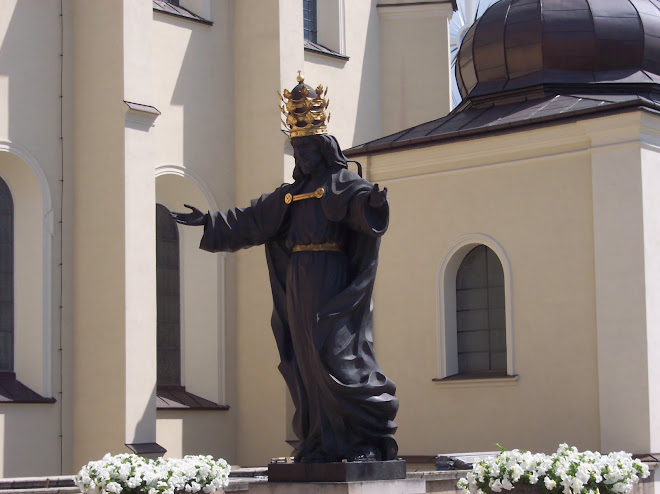
Our Lady's Presumptive Close
Happy Feast of the Immaculate Conception.
I love this miracle because it is, after all, the first recorded, and it's about Holy Fun.
Weddings should be great fun (in Poland the reception normally lasts 3 days) and alcohol is part of the fun.
Jesus' mother (unnamed in John's Gospel) told Jesus, "They have no more wine," and Jesus replied, "Dear woman, why do you involve me? My time has not yet come." Jesus' mother then said to the servants, "Do whatever He tells you" (John 2:3-5). Jesus ordered the servants to fill the empty containers with water and to draw out some and take it to the chief waiter. After tasting the water that had become wine, and not knowing what Jesus had done, he remarked to the bridegroom that he had departed from the custom of serving the best wine first by serving it last (John 2:6-10). John concludes his account by saying: "This was the first miracle of Jesus and it was performed to reveal His glory, and His disciples put their faith in Him (John 2:11)".
I'm fascinated also by the psychology. Mary was a very clever woman, and knew a thing or two. Notice how, when Jesus demurs, she says, "Do whatever He tells you."
As a trainee salesman, I was taught the 'presumptive close'. The 'close' is the prospective client's decision to buy. The presumptive close involves behaving and speaking as though he or she had already agreed. Classic, though cheesy and not always very successful presumptive closes are:
How would you like to pay for this, Mr Prospect, monthly or annually?
When do you want your policy to start?
Shall we put it in trust for your wife? How do you feel about that, Mrs Prospect?
And Mary, much too clever for such obvious approaches, but using the technique of presuming that Jesus will do something, simply says, "Do whatever He tells you."
After that, how could Jesus extract himself from performing the required miracle. We know that sometimes presumption can be a sin. Voltaire's, "Dieu me pardonera - c'st Son metier" is a classic example, but the spirit which cries out, "Abba, Father" can wheedle. Our Lady is our Mother too, and she can wheedle better than anyone, being His Mother, bodily in Heaven, and never tainted by original sin.
And if we needed the stamp of authenticity on the idea that we can be good, and have fun, this miracle is it.
Dzięki Bogu! Thank God!


This Pontificate Might Just Have Become Shorter.
-
And it came to pass that yours truly took some days of, in his certainly
wrong estimation, deserved rest. A holiday from the poison of having to see
the Ch...
17 hours ago




5 comments:
Good post, this parable was read at my wedding (eons ago). It is a wonderful parable, especially highlighting, as it does, a wonderful relationship between a knowing Mother and a reluctant Son.
Happy feastday, Christopher.
Thank you Richard, but is it a parable? Our Protestant R.I. teacher certainly said it was, and that the wine was, of course, alcohol-free (huh!).
Happy Feast Day.
Mmm, maybe I was too hasty in my use of the word 'parable' as we tend to think of those as being the exemplar type accounts given to us by Christ.But my memory from my RE lessons tells me that The Marriage Feast was described as a parable.And, surely, a parable is a story with a moral to it?
I am uncertain, but I am sure that the wine was alcoholic!
Great post - love the bit about presumptive close. I'm going to steal it for my lectures...
By the bye, it's not just wine that Our Lady favours!
http://benedictxvihouse.blogspot.com/2010/12/ale-holy-queen.html
Great post!! The presumptive close was an excellent move on Mary's part. Plus, it showed her total confidence in Jesus.
Mother's intuition?
Post a Comment